


Over the last few years, I’ve been exploring the shape of mission-driven governments and the need for a fundamentally different approach to decision-making—one capable of navigating uncertainty, not simply delivering outputs.
In Unfit for Uncertainty, I argued that the UK state is structurally ill-equipped to operate in conditions of complexity, relying on linear models of analysis, static evidence bases, and decision processes designed for stability rather than change. I pushed this further in Beyond the Waterfall State, exploring how these dynamics play out in practice, and what a possible alternative decision-making architecture might look like – and what it would take to deliver it.
Both pieces converge on the same deeper question: what does a “healthy” government system actually look like? Not in abstract terms, but in terms of capability. Such a system is not defined by any single method or reform. It is defined by its ability to generate, absorb, and act on different types of knowledge – to hold multiple perspectives at once, to interrogate its own assumptions, and to learn in motion. But if this is what capability looks like, where does it actually sit within the state? The institutional locations of these capabilities remain unresolved.
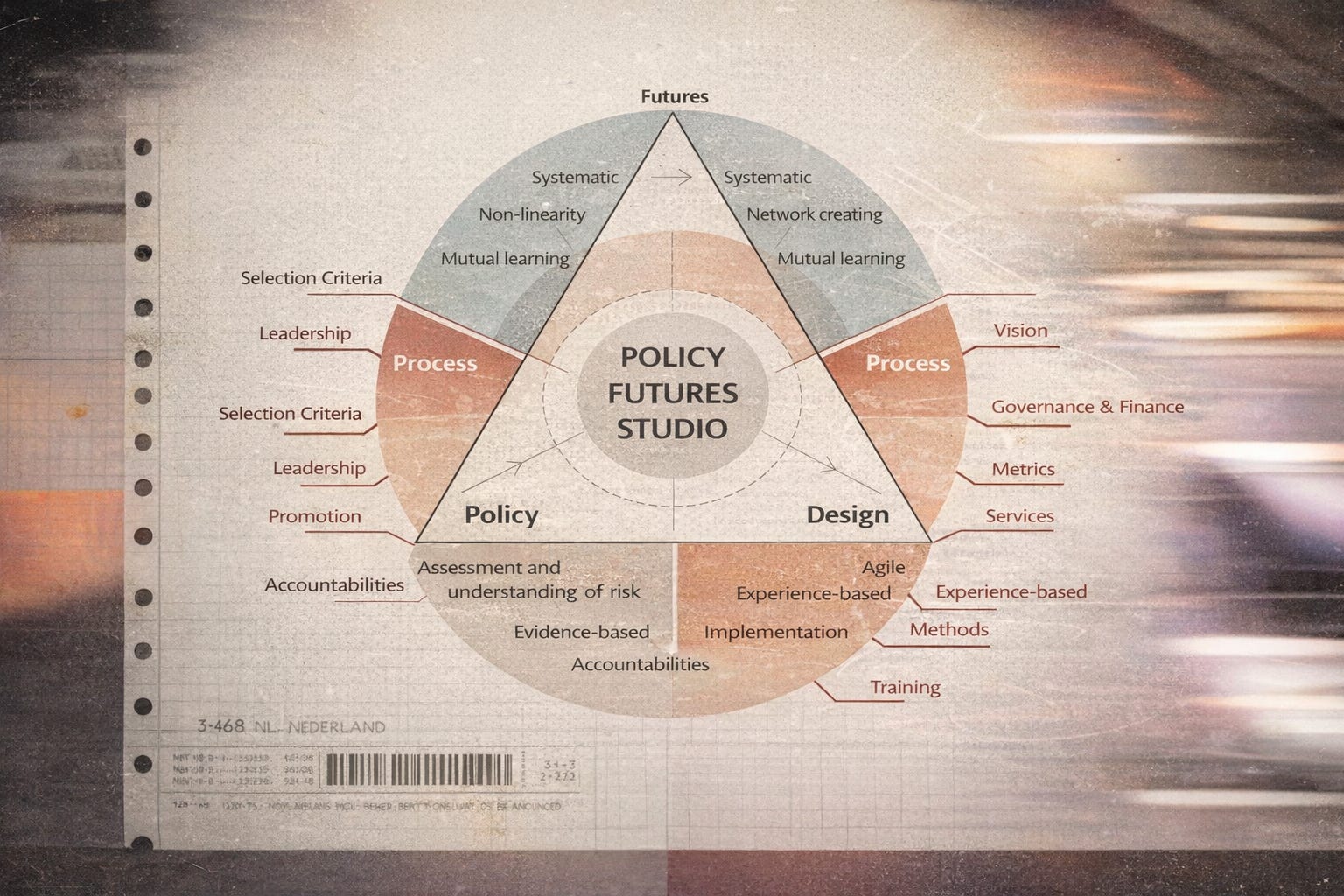
One route into this question comes through my experience working within HMRC’s Policy Lab, alongside futures and foresight practice more broadly, and what Jon Kolko describes as “studio culture.” I’ve long admired Lucy Kimbell’s 2019 paper “What if there were more Policy Futures Studios?”, where she proposes a model for embedding futures thinking more directly within policymaking – moving beyond episodic foresight exercises toward more situated, practice-based forms of inquiry.
Picking up this thread, this article looks to (re)imagine the “lab model” as Policy Futures Studios – not as niche functions or experimental units within Government, but as a missing piece of institutional architecture capable of supporting more anticipatory, adaptive forms of decision-making within the state.
Futures as insight not infrastructure
Futures practices matter – particularly if we take seriously the idea that governments must operate not only in response to present conditions, but in relation to multiple possible futures. This requires a capacity to both keep the lights on and shape the future – something that cannot be achieved through delivery-focused models of policymaking alone.
And to some extent, these capabilities already exist. Across government, futures and foresight functions are distributed through horizon scanning teams, strategy units, and innovation labs. The Government Office for Science has codified approaches through horizon scanning, scenario planning, and trend analysis. Policy Lab has developed experimental futures methods to support policy development. Even the Home Office, as part of their Research, Development and Innovation strategy in 2025, identified futures as one of 14 internal RDI capabilities.
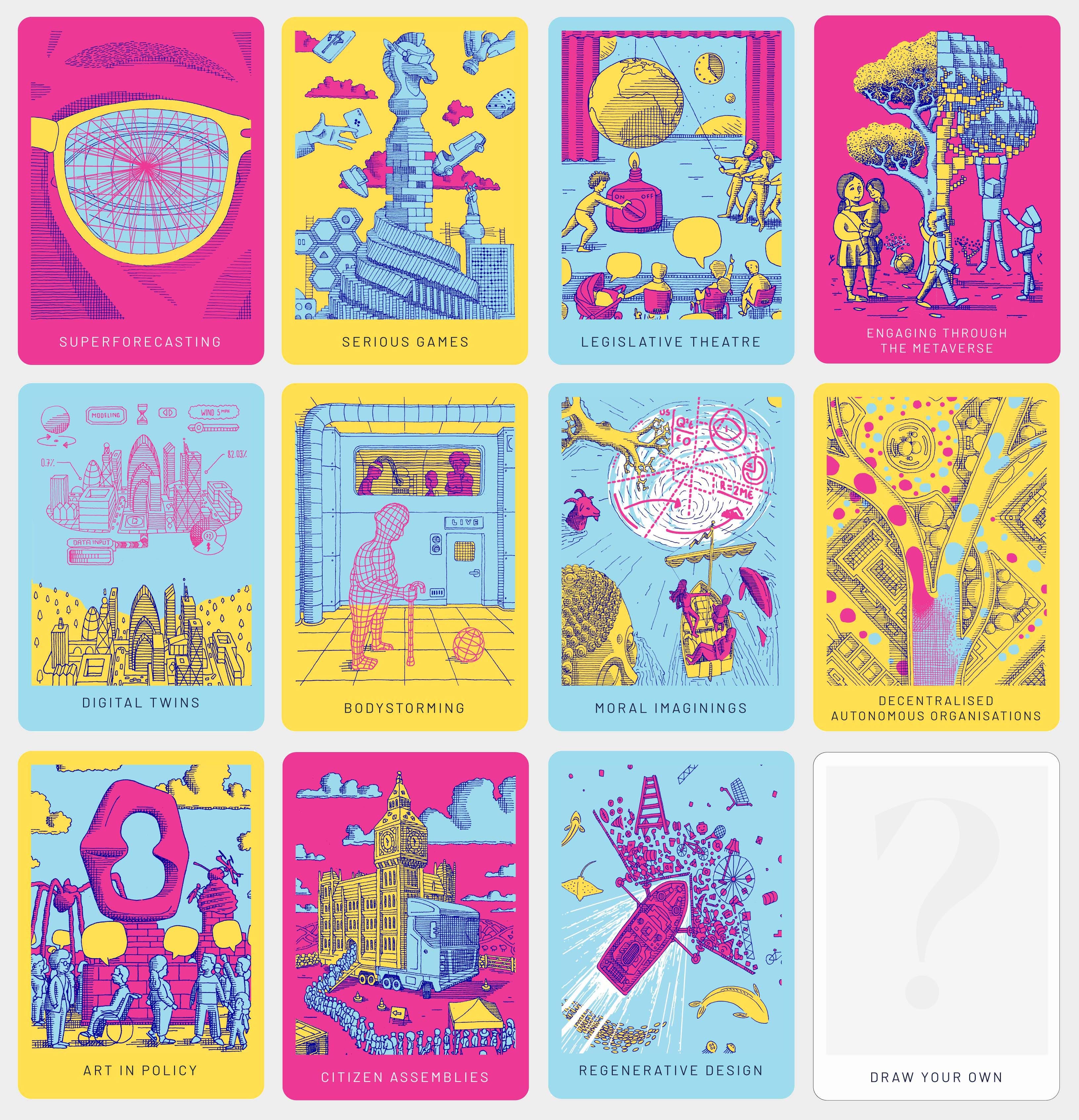
Futures, in other words, is not absent from government. It is just not where decisions are made.
And yet, despite all this activity, most policy decisions continue to be made as if the future were broadly knowable, stable, and reducible to a set of assumptions.
The issue is not the limits of futures methodologies, nor the complexity of the systems they seek to shape. It is the way these practices are positioned within the state. Futures work remains structurally disconnected from decision-making. Insight is generated, reports are written, signals are identified – but when it comes to allocating resources, defining policy direction, and making trade-offs under uncertainty, these capabilities sit at the margins.
They are, more often than not:
episodic – conducted as projects, rather than sustained as capabilities
adjacent – informing decisions from the outside, rather than shaping them from within
non-binding – generating insight without consequence
This helps explain why futures work so often struggles to demonstrate impact. Even where capability exists, it often arrives too late – or remains too detached – to influence the decisions that matter most.
We are attempting to build a mission-driven government without an anticipatory core.
From foresight to statecraft
If futures practice is to play a meaningful role in mission-driven government, the question is not simply how to improve its methods. It is how to reposition it within the architecture of the state itself. This is where the distinction between foresight and statecraft becomes important – and where I want to spend a moment, because I think it’s the crux of what this piece is really about.
Foresight, as currently practised, is largely concerned with producing insight about the future. Statecraft is concerned with how decisions are made under conditions of uncertainty – how institutions interpret signals, structure choices, and act in the present in ways that shape long-term outcomes. Moving from one to the other is not a methodological shift. It is an institutional one (Read more on Mission Critical Statecraft).
Foresight asks: what might happen? Statecraft asks: how do we decide, given that we cannot know?
Government has invested heavily in the first question. It has done far less to build the institutional conditions for the second. The result is what Jen Pahlka calls “policy vomit“ – where the words of policy are pushed, essentially undigested, into the administration of a policy, without the benefit of thinking, learning, or iteration. Futures insight suffers the same fate: generated upstream, absorbed downstream, and rarely allowed to alter direction in between. What accumulates instead is the institutional spaghetti of policy, delivery, and technology that so many of us recognise.
This is the gap that Policy Futures Studios are designed to occupy – not as a rebranding of existing labs or foresight units, but as a form of organisational infrastructure capable of operating across, and at times cutting through, the accumulated weight of legacy processes and fragmented mandates. Not another layer of activity. A different way of organising how policy problems are engaged with.
What a Policy Futures Studio actually is
At their core, Policy Futures Studios would operate as sites of structured inquiry within the state, bringing together futures practice, policy design, and systems thinking to support decision-making and delivery under conditions of uncertainty.
Crucially, their role is not to produce standalone artefacts – reports, scenarios, or speculative outputs. It is to work directly with policy and strategy teams to reconfigure live problems and deliver credible policy and service outcomes. This means temporarily stepping outside the constraints of existing policy and delivery environments in order to reimagine the intent, experience, and operational logic of a given problem – before translating that back into the organisation in forms that can be tested, implemented, and scaled.
In this sense, they are less concerned with prediction, and more concerned with making uncertainty actionable. These interventions might take the form of new policy propositions, redesigned services, or alternative organisational arrangements – developed as prototypes or pilots that allow ideas to be tested in practice, rather than remaining at the level of abstraction.
This is what begins to move futures work out of the realm of insight generation and into the realm of applied institutional change.
The language of the “studio” is not incidental, either. As Jon Kolko describes, studios are not simply places where ideas are generated, but environments in which problems are actively worked through – iteratively, collaboratively, with a close coupling between thinking and making. When applied to government, this suggests a shift from abstract strategy toward situated experimentation – where policy is developed through cycles of exploration, prototyping, and testing, rather than defined upfront and delivered downstream.
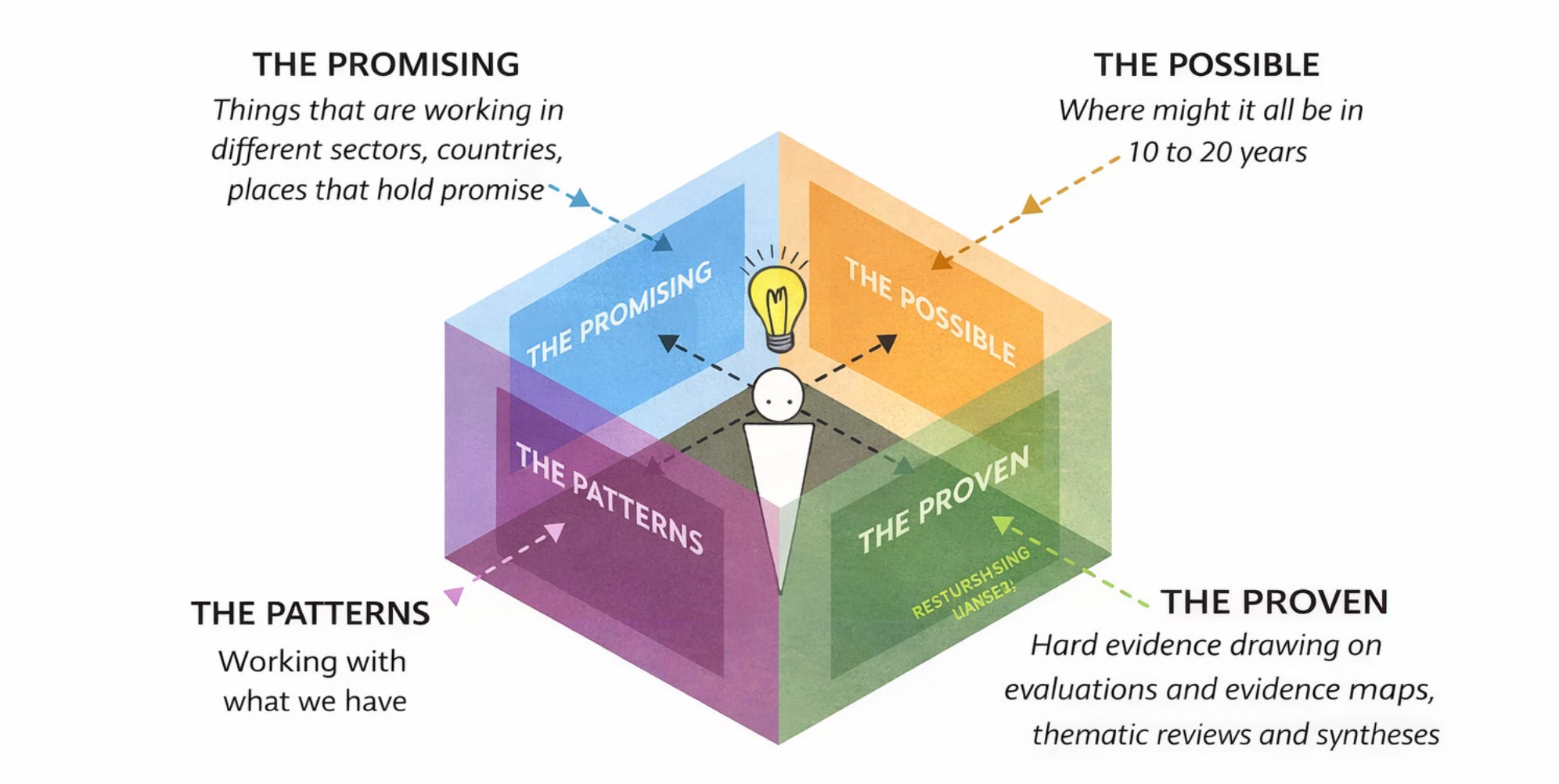
To make this institutional form more tangible, I find it useful to think through five interrelated design components – drawing on existing work on lab frameworks and relational infrastructure (See Anna Whicher & Sam Rye), but extending into a more explicitly decision-oriented context. A Policy Futures Studio can be understood not simply as a team, but as a structured environment for inquiry, design, and implementation, organised through: (1) purpose and proposition; (2) product and prototypes; (3) people and capacity; (4) process; and (5) place.
(1) Purpose and proposition — intervening in how decisions are made
The purpose of a Policy Futures Studio is not to produce insight about the future, but to intervene in how decisions are made in the present. Most futures work assumes that better knowledge leads to better decisions. In practice, insight accumulates, but decisions remain shaped by fixed problem definitions, institutional constraints, and delivery pressures.
Policy Futures Studios operate within this gap — reconfiguring how policy problems are understood, structured, and acted upon under conditions of uncertainty. This means working both at the point where problems, options, and trade-offs are still fluid, and where existing policies and services have become constrained by legacy assumptions and accumulated complexity.
What makes this different from conventional policy processes is not the tools, but the mode of engagement. Studios are designed to hold problems open for longer, working across multiple framings and deliberately avoiding premature convergence. This is not about slowing decision-making, but about changing when and how decisions are stabilised — so that choices are made with a fuller understanding of the systems they are reshaping.
This work is done with policy and delivery teams, not for them. The aim is not to reduce uncertainty, but to increase the state’s capacity to navigate and act within it — building shared understanding, exposing trade-offs, and enabling decisions that are better grounded in the realities of the system.
(2) Product and prototypes – making decisions tangible
The “product” of a Policy Futures Studio is not insight, but interventions that make policy decisions tangible, testable, and open to challenge. Rather than producing reports or recommendations, studios work through a set of outputs that sit closer to action: propositions, prototypes, and live interventions that allow ideas to be explored in practice – through delivery – not just described in theory. This is essential to bridging the gap between policy and delivery.
Propositions articulate alternative ways of framing a problem or organising a response–making explicit the assumptions, trade-offs, and implications that are often left implicit in policy development. They are not final answers, but structured positions that can be interrogated, compared, and evolved.
Prototypes take this further. Drawing on Sam Rye’s thinking on relational infrastructure, prototypes are not simply early versions of solutions, but devices for reorganising relationships within a system. They make abstract ideas concrete, allowing different actors to engage with them, contest them, and understand their consequences. In doing so, they shift conversations from speculation to experience – changing how decisions are made by grounding them in something that can be seen, tested, and responded to. This might take the form of a reconfigured service journey that exposes operational constraints, a policy mechanism modelled through a pilot, or alternative delivery arrangements enacted at small scale.
Live interventions extend this logic into the system itself – testing propositions and prototypes in context, generating feedback, revealing unintended consequences, and creating the conditions for iteration before decisions are locked in.
Taken together, these outputs create a different relationship between thinking and doing. They enable policy to be developed through cycles of exploration, testing, and refinement, rather than through linear stages of analysis followed by delivery. The result is not just better evidence, but evidence that is produced through action – grounded in the realities of implementation, and capable of shaping decisions as they unfold.
(3) People and capacity – unlocking capability from within
The effectiveness of a Policy Futures Studio does not depend on assembling a new team of specialists. It depends on identifying and working with the right people already inside the system.
Across government, there are genuinely talented individuals with deep domain expertise – policy professionals, analysts, service designers, operational leaders – who understand where the system is not working, where assumptions no longer hold, and what would need to change. They are often closest to the problem, and yet furthest from the conditions required to reshape it.
Policy Futures Studios are designed to work with and elevate this existing capability, not replace it. Rather than acting as an external intervention, the studio creates a space where these individuals can operate differently: with greater agency, access to different tools and perspectives, and the permission to question, reframe, and test ideas in ways that are often difficult within standard policy environments.
Capacity, in this sense, is not a question of headcount. It is about how capability is activated, connected, and sustained over time.
(4) Process – working above and across the system
The process of a Policy Futures Studio cannot simply replicate existing policy processes. If it did, it would reproduce the same constraints it is intended to challenge.
Studios operate alongside, across, and at times above bureaucratic processes – creating conditions to reframe problems, test ideas, and explore alternatives without being immediately constrained by existing procedural requirements. This does not mean bypassing governance or avoiding accountability. It means sequencing engagement differently – intervening earlier, before decisions are fixed, and creating space for exploration before formal processes begin to close options down.
Studios focus on problems where uncertainty is high, the stakes of getting it wrong are significant, and existing approaches are struggling to make progress. The process is not linear. It moves iteratively between exploration and intervention – working through propositions and prototypes, testing them in context, and using what is learned to reshape direction.
Crucially, this also means reimagining the processes themselves. If policies and services are being rethought, then the bureaucratic routines that produce them – approval pathways, evidence standards, sequencing of decisions – must also be open to redesign.
Studios therefore operate not only on policy problems, but on the processes through which those problems are addressed. Over time, this creates a dual effect: decisions improve, and so do the conditions under which future decisions are made.
(5) Place – from space to sociomaterial infrastructure
The idea of the “studio” is not incidental. It speaks to a different kind of place within the state.
As Jon Kolko suggests, place is not simply space. Space is possibility; place is what emerges when that space is shaped by shared practices, norms, and ways of working. Policy Futures Studios are designed as this kind of place – not just a physical environment, but a sociomaterial infrastructure in which new ways of working can be enacted.
Within a Policy Futures Studio, place becomes a medium for working through problems. Prototypes, conversations, visualisations, and artefacts accumulate over time, creating a shared reference point that allows ideas to be interrogated, contested, and evolved. Through repeated participation, people don’t just contribute to the work – they begin to internalise a different way of working. Drawing on Sam Rye, this can be understood as the creation of relational infrastructure: the environments, artefacts, and interactions that shape how people come together to act. In this sense, place is not background. It is an active component of how capability is formed.
This is what allows the studio to function as more than a project environment. It becomes a site of practice, where new forms of decision-making are not only explored, but rehearsed and embedded. As people move back into their respective domains, they carry these practices with them – shifting how work is done elsewhere in the system.
Place is not just where the work happens. It is how the work becomes durable.
Bringing it together – and being honest about what I don’t know
Taken together, this positions Policy Futures Studios not as discrete teams, but as part of a broader capability infrastructure within the state – one that supports how knowledge is generated, interpreted, and acted upon across domains.
But I want to be honest about the tension this piece hasn’t fully resolved.
I’ve argued that studios must work within decision-making rather than alongside it. And yet, the five components I’ve described still risk looking like something adjacent – a temporary architecture, a space to step into. The harder institutional question – how a studio gains the authority to actually reshape live decisions, rather than inform them from a comfortable distance – is one I’m still working through.
What I’m increasingly convinced of is this: legitimacy in this space is built through action, not insight. Studios that start by producing reports will be treated as report-producers. Studios that start by taking on live problems – messy, high-stakes, politically loaded ones – and demonstrably improving them, will be treated differently. That’s not a design principle. It’s a bet on how institutional trust actually accumulates.
In practice, this begins small. Not with a fully-formed team, but with a small number of live problems where uncertainty is high and existing approaches are struggling. The work starts by assembling the right people around these problems and working with them to reframe, prototype, and intervene in ways that shape decisions in real time.
From there, the work expands not through scale, but through demand – creating pull within the system to embed this way of working more deeply over time.
That feels like the right starting point. Whether it’s sufficient is, honestly, still an open question.
Rainer, congratulations. This is one of the most important articles I read in the last year. I will get in touch with you to explore implementing the ideas in the context of some ongoing projects in Rio, at our Brazilian School for Advanced Studies
Thank you Jack!
It is not just the futures we list, but the futures that are created by what we are doing today. For example. The situation we are in today with the NHS waiting lists, rising costs of social care, etc. These were all predicted a long while ago. Addressing this years ago would have been far easier.
‘how do we decide, given that we cannot know? ‘ thats a good question because it jolts our idea that we can use KPIs and measures to understand what is and what will occur. We can prove that we cannot, despite how well crafter our measures are.
A definition of Complexity shows us that we cannot predict that which is complex. By ignoring this truth, we are simply deluding ourselves.
Yes, positioning statecraft within government under current design and thinking, will simply produce another silo to go through.
As for further thoughts, I note that you still focus on government and the creation of policy. I agree that statecraft has to be a different way of designing and working.
There is one thing I was looking for, your definition of the system you are describing, And it seems you retain the boundary of the system around government & the civil service. But the public sector includes local government and communities. The knowledge that can only be used for statecraft lies in local government, and not in the metrics they supply back to the centre. Local government is not ‘delivery’, it is both where the value is created, the knowledge of what works, and the knowledge of what needs to be done is retained. Surely they need to be at the centre of this?