


This post reflects on an article I recently published for Recurve on neighbourhood missions and social infrastructure.
Since the announcement of the UK’s Pride in Place programme – a £5 billion, decade-long investment intended to regenerate high streets, tackle deprivation and renew entire areas – there has been a steady stream of thoughtful work on neighbourhood renewal. From the Local Government Association’s Growth and Reform Network and the Independent Commission on Neighbourhoods (ICON) to Local Trust’s Big Local and Place Matters, there is no shortage of strong analysis of the structural conditions shaping neighbourhood decline.
What remains far less developed, however, is how these diagnoses are translated into meaningful policy action outside the dominant logic of growth agendas.
This is no criticism of the quality of these reports. The problem lies elsewhere. While neighbourhoods are increasingly treated as complex social, institutional and civic systems, policy responses are still filtered back through an economic paradigm designed for sectoral growth, programme rollout and aggregate outcomes. The result is a familiar slippage: relational diagnoses, followed by transactional, often technocratic, recommendations (See: A City Is Not a Computer).
In this Recurve piece, I explore why neighbourhood renewal policies struggle not because of a lack of evidence or ambition, but because they remain spatially blind in practice. Not because they ignore context, but because the mechanisms for turning diagnosis into action remain rooted in bureaucratic hierarchies that struggle to work with local complexity and relational depth.
This is not an argument against economics. Neighbourhood policies that focus on jobs, skills, transport and investment all matter. But economics alone is an insufficient organising frame for neighbourhood renewal. As Polly Mackenzie argues, if decline were only about economics, many of the places that continue to exist against the odds simply wouldn’t.
What this points to is an institutional problem, not a market one.
Drawing on work from Hilary Cottam, Sam Rye at Monash University, and research on mission-oriented innovation and neighbourhood renewal, this article argues that despite acknowledgement that relationships are central to sustained, transformative change, public systems designed around managing needs and delivering transactions systematically underinvest in relationships, and that we need greater attention to social infrastructure institutions: intermediary organisations that steward relationships, integrate fragmented systems, and hold learning and coordination over time.
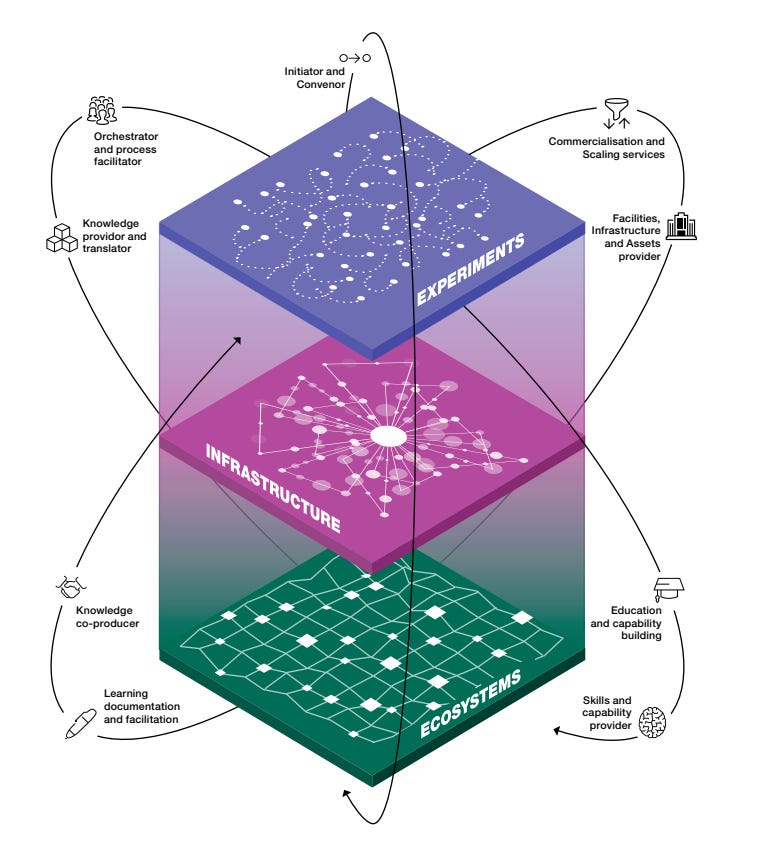
Highlighting Citizen Hub in St Neots, alongside the Monash University living labs model, the article shows how neighbourhood renewal depends not just on programmes, but on institutions capable of sustaining change.
You can read the full Recurve article, The missing middle: why Labour’s neighbourhood missions need social infrastructure, here: https://www.recurve.solutions/insights/rebuilding-missing-middle
As ever, I’d be very interested in reflections – especially from those working within this messy interface between policy, place and practice.