


This post is a prototype. It’s ten years of thinking about products, services, systems and transformation coming together through my work at CustomerFirst, where we’ve been thinking deeply about the role of experimentation in government – its value, what it reveals, what it is and (importantly) what it is not.
Put simply, this article is about the practice of putting something real into a system, however small, and discovering why things work as they do, revealing what might otherwise stay hidden in organisational charts, process maps and the carefully designed operating models we often hold so tightly. It begins to explore what happens when we move beyond designing service transactions and start experimenting with the materials of an institution, learning how they behave, how they might be rearranged and what it takes to make change possible in organisations steeped in their own organisational treacle that has shaped how it operates over time.
Treat this essay as version 0.1.0 alongside an interactive prototype, synthesising my experiences of experimentation as a practice in the public sector. There’s probably a chapter to be written about each of the ideas explored here, but I’m all for sharing early and often, and wanted to get this thinking into the world while we’re still developing it through practice.
Experimentation as probes
So what do we mean by an experiment? Semantics can be contentious, but for me, in the context of the test and learn approach we’re trying to kindle, experiments are deliberate attempts to learn what happens when we try something different in real conditions. We start with an idea of what might happen, decide what we’d need to see to learn from it, and try it at a scale where we can manage the uncertainty. Often that means making a small change to a live service.
Take a relatively simple example from our work with DVLA. Much of the process of deciding whether someone is medically fit to drive still depends on letters travelling back and forth through the post. This can mean the wait is simply for a letter to arrive, rather than anyone making a decision. So we experimented with the ability to return information digitally. An obvious idea, in some respects, but there must be a reason why this hadn’t been delivered already, right? So, we selected a specific use case with a small sample of 100 real customers to experiment with our idea.
To be clear, the purpose of this experiment was less to prove that letting customers return things digitally was a good idea (giving people equal access across channels is a basic service standard after all), and more to probe the system to understand how everyone around it would behave when we tried to change something, and hopefully reveal the friction that has prevented this from happening before.
It’s a small example, sure, but it brought us face to face with the people around the service, from customers experiencing the wait and contact centre colleagues hearing their frustrations, to the casework, policy and operational colleagues who helped us understand where there was room to try something different. In this case, although legislation required certain letters to be served in writing, that didn’t necessarily mean the replies had to be on paper too. Yet we’d been assuming they did. Because, well, that’s what DVLA had always done. What looked like a question about a digital form suddenly draws you into the relationship between law, its interpretation and the operating practices built around it. You start to work with the materials of the institution itself, discovering how they had been arranged around the existing service and where you might rearrange them to make something different possible.
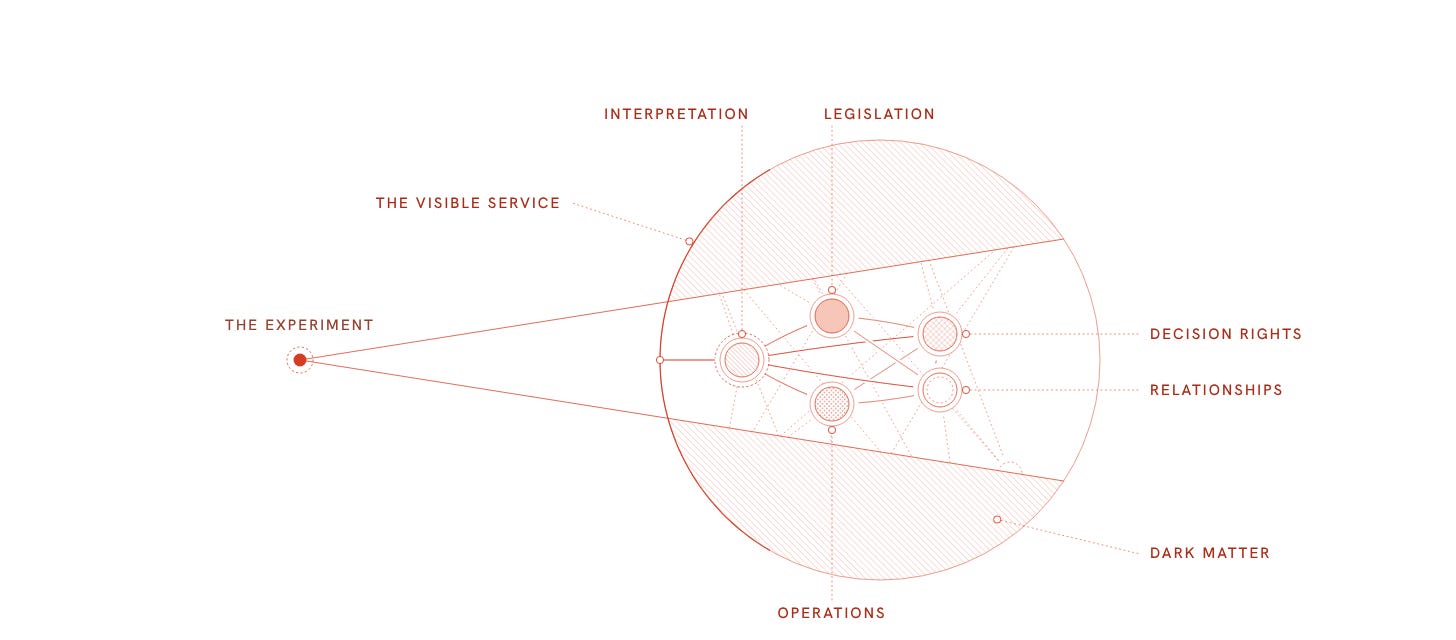
I’m, as ever, inspired by Dan Hill and the idea of “dark matter probes” he borrows from Bryan Boyer, dark matter being the rules, relationships and habits that sit behind everything we can see. And I think this is exactly where the value of experimentation lies. Discovering what an institution is made of, where its arrangements can be challenged and what might become possible if we started designing with those materials rather than treating them as fixed conditions around our work. How an organisation responds to that pull tells us as much about its capacity to change as the experiment tells us about our idea, and it’s often a first taste of the organisational treacle that slows transformation down.
This is what makes experiments such good probes. They reach into parts of the organisation we might otherwise struggle to see, pulling, poking and prodding, and we get to see what gets stuck.
Experimentation as navigation
Once an experiment like ours is live you can very quickly find yourself wading through this treacle of organisation change in several directions at once, through an organisation’s culture, its operating model and its technology estate. I see it as a kind of three-dimensional space, one an experiment lets you move through, learn from and occasionally bend, at different scales and speeds of a system.
Getting a little nerdy for a moment, I think there’s something quite exciting about bringing together Mark Moore’s thinking about creating public value, Stewart Brand’s pace layers, and the way Dan Hill has stretched these ideas into strategic design practices for public purpose. Each gives us a different way of understanding what happens when we try to change something inside an institution. Put them together (as I’ve attempted to do with this interactive prototype), and I think we get a pretty rich way of seeing how experiments move through an organisation, what happens when different parts of it respond, and what we learn along the way.
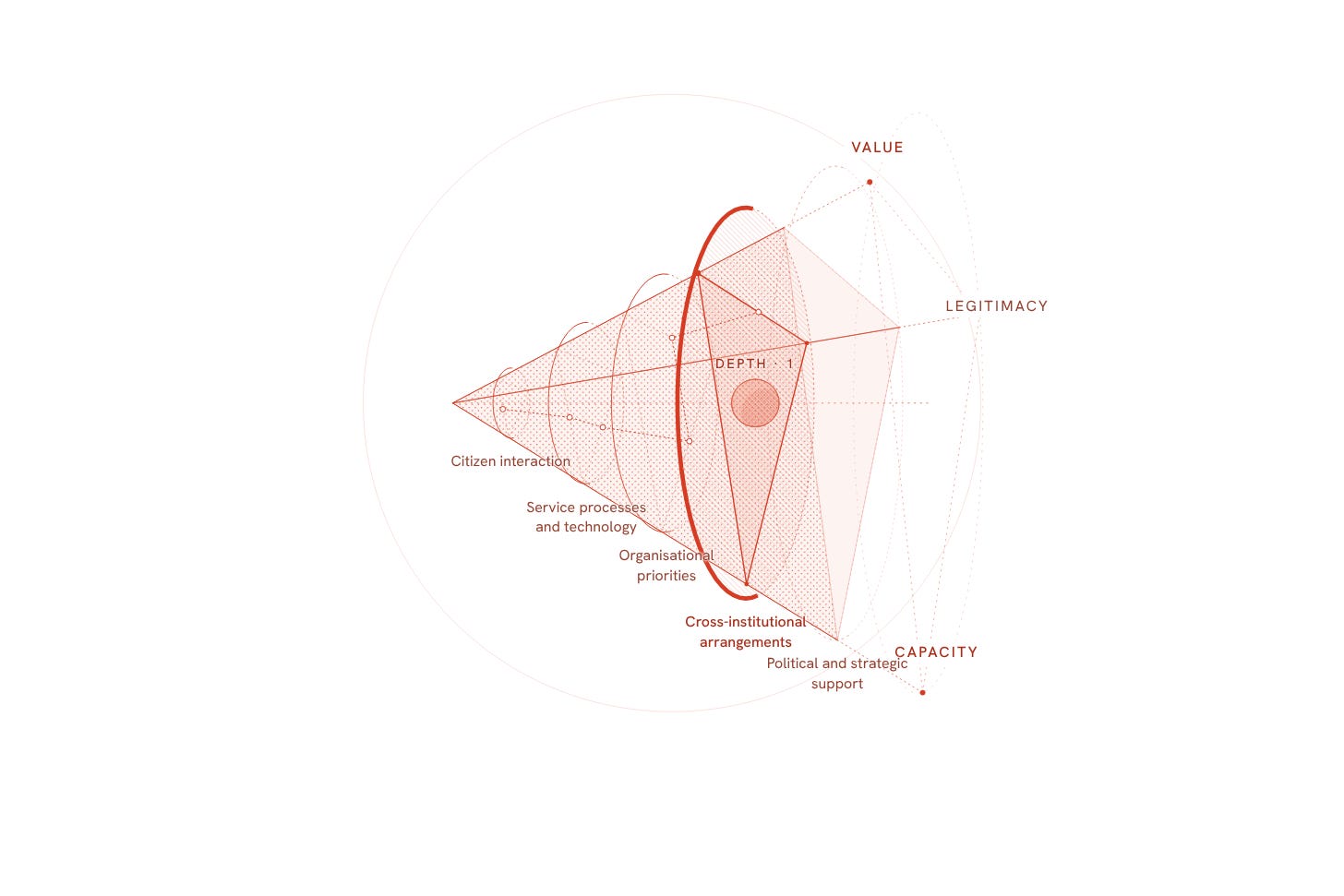
Horizontally, you’re constantly moving between questions of value, legitimacy and capacity, learning how these different demands respond when you try something new. Will people use what we’ve made, and what value might it create? Do we have the support and permission to pursue it? Can the organisation actually deliver it? And at which scale does each question apply?
In our case, people used the digital route, which answered the first question well enough. Just getting permission to try it took weeks of privacy, policy and legal conversations, and that was the second. The third was the colleagues who’d handle each reply, and whether they had the room to.
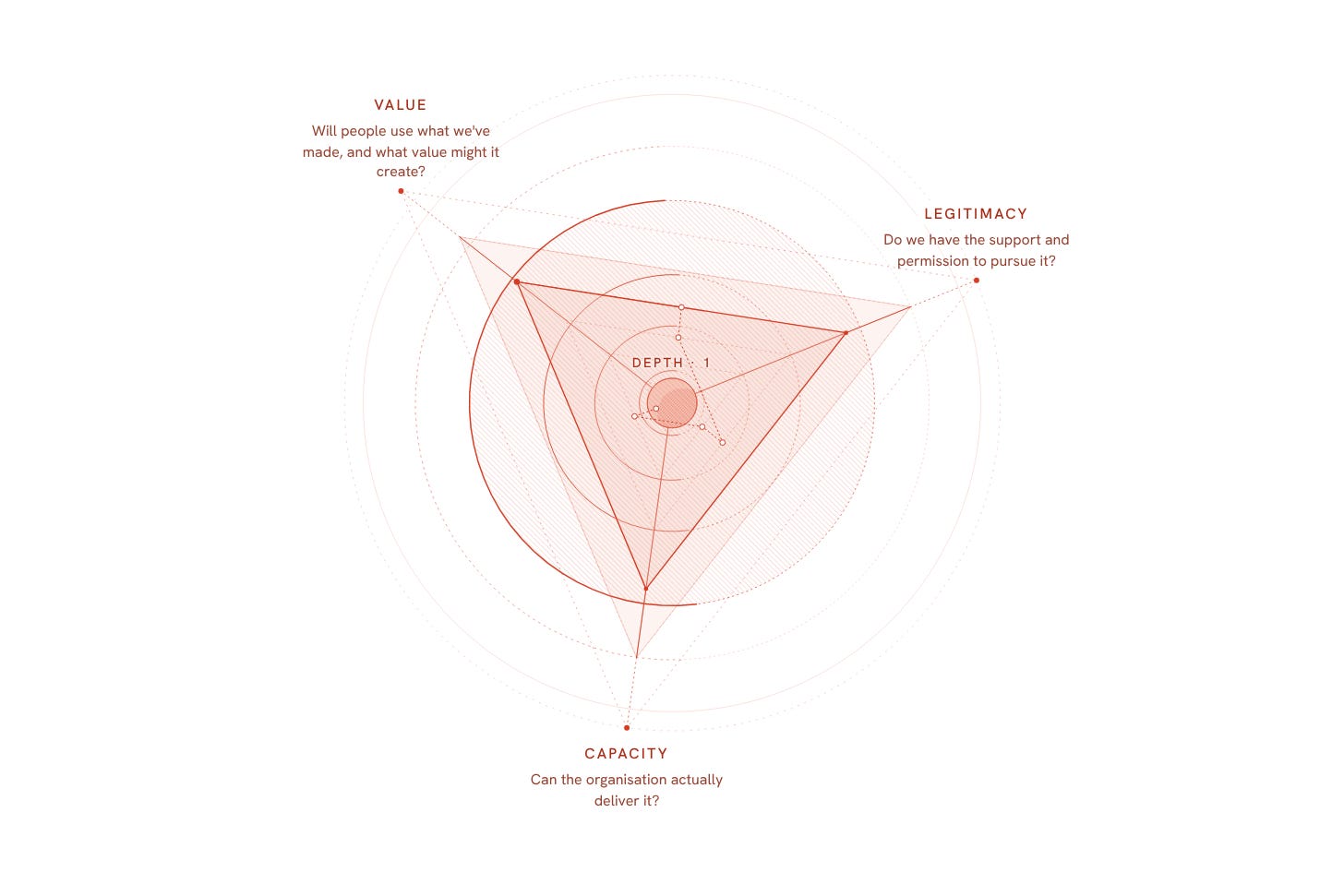
Each question brought different people and responsibilities into the experiment, and answering one didn’t necessarily settle the others. The balance between what is valuable, what has legitimacy and support, and what an organisation can sustain shifts as you learn, sometimes changing the very thing you’re trying to test.
At the same time, you’re moving vertically through the layers of an institution, learning how the implications of a small experiment reach into larger contexts, each changing at its own pace. On its own, for example, returning a form digitally is a fairly simple interaction between a person and a service. But that interaction sits within a process for deciding whether someone is medically fit to drive, which relies on technology, caseworkers and operational arrangements that have developed over years. That process sits within an organisation with its own priorities, budgets and responsibilities, which in turn operates within wider institutional and political commitments. Suddenly, returning a form digitally isn’t really a question about the form at all.
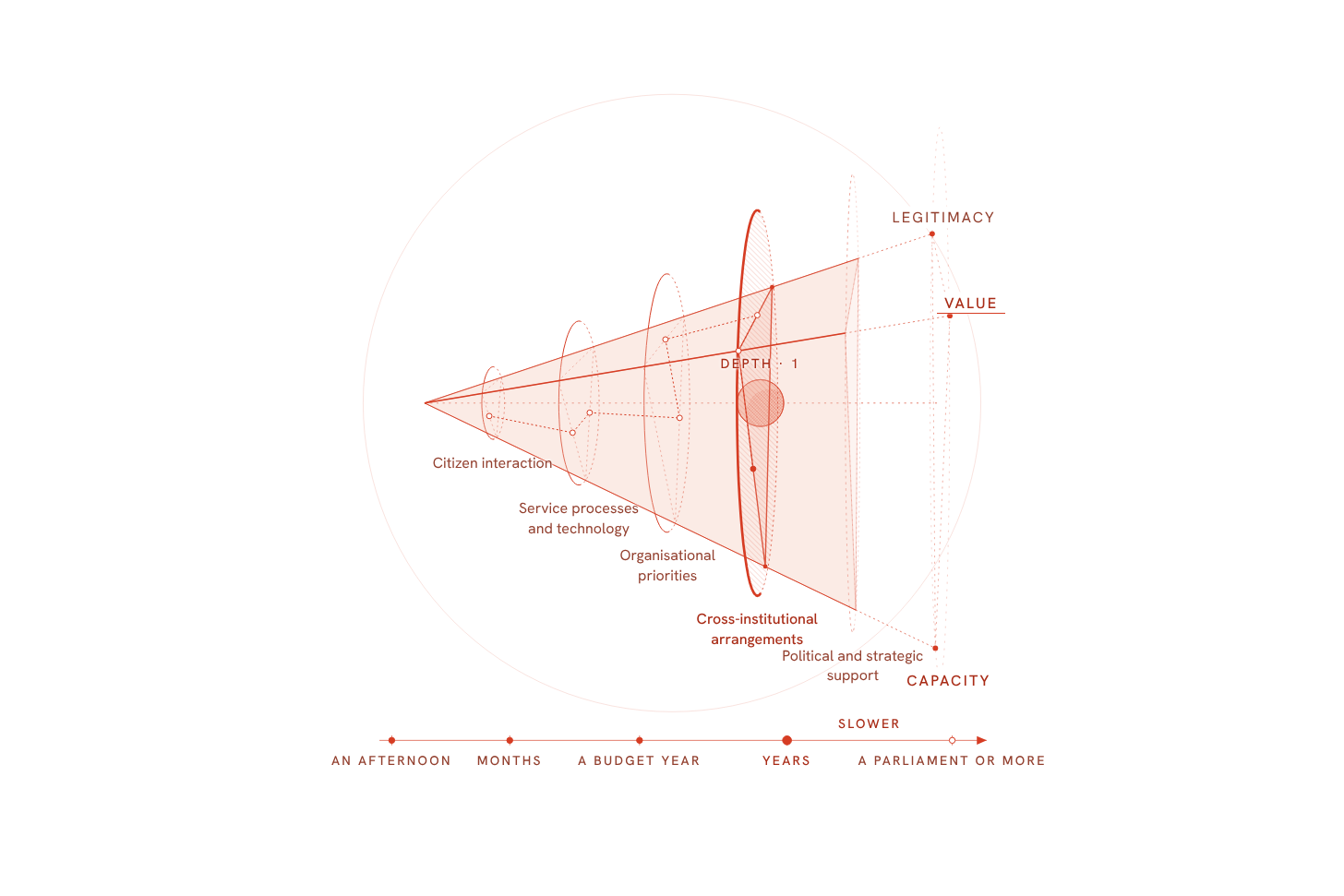
This is essentially systems thinking 101, always designing something by considering its next larger context. In practice, though, these layers don’t move together (of course they don’t!). A customer interaction might be changed in an afternoon, while the systems and processes behind it take months. Organisational priorities, funding and institutional commitments move more slowly still, having built up through years of decisions about how the service should work.
As Brand puts it, “fast gets all our attention, slow has all the power”. This slowness isn’t necessarily a problem to overcome. Some of it is what allows an institution to maintain its responsibilities while everything else changes around it.
For us, it has meant intentionally designing experiments to reach into the layers above and around the initial test. Making a digital route work for a small group was one thing; making it last would mean the capability being prioritised, paid for and owned. So from the moment we define an experiment, we need to think about the questions those slower layers will ask. Who would own this? What would it cost to do properly? And what on earth is the governance process for a change like this? These aren’t questions you can answer yourself, but you can bring the people who might answer them close enough to see the experiment happen.
The third dimension, and the one I find most interesting (and often underserved), is depth. Depth is about how far experimentation takes us into the interactions between the materials, relationships and decisions through which public value is created. These connections run within and between the other dimensions, sometimes reaching surprisingly far from the initial intervention. How deeply we explore them depends on what the experiment encounters, the questions we pursue and what happens when we try to change something.
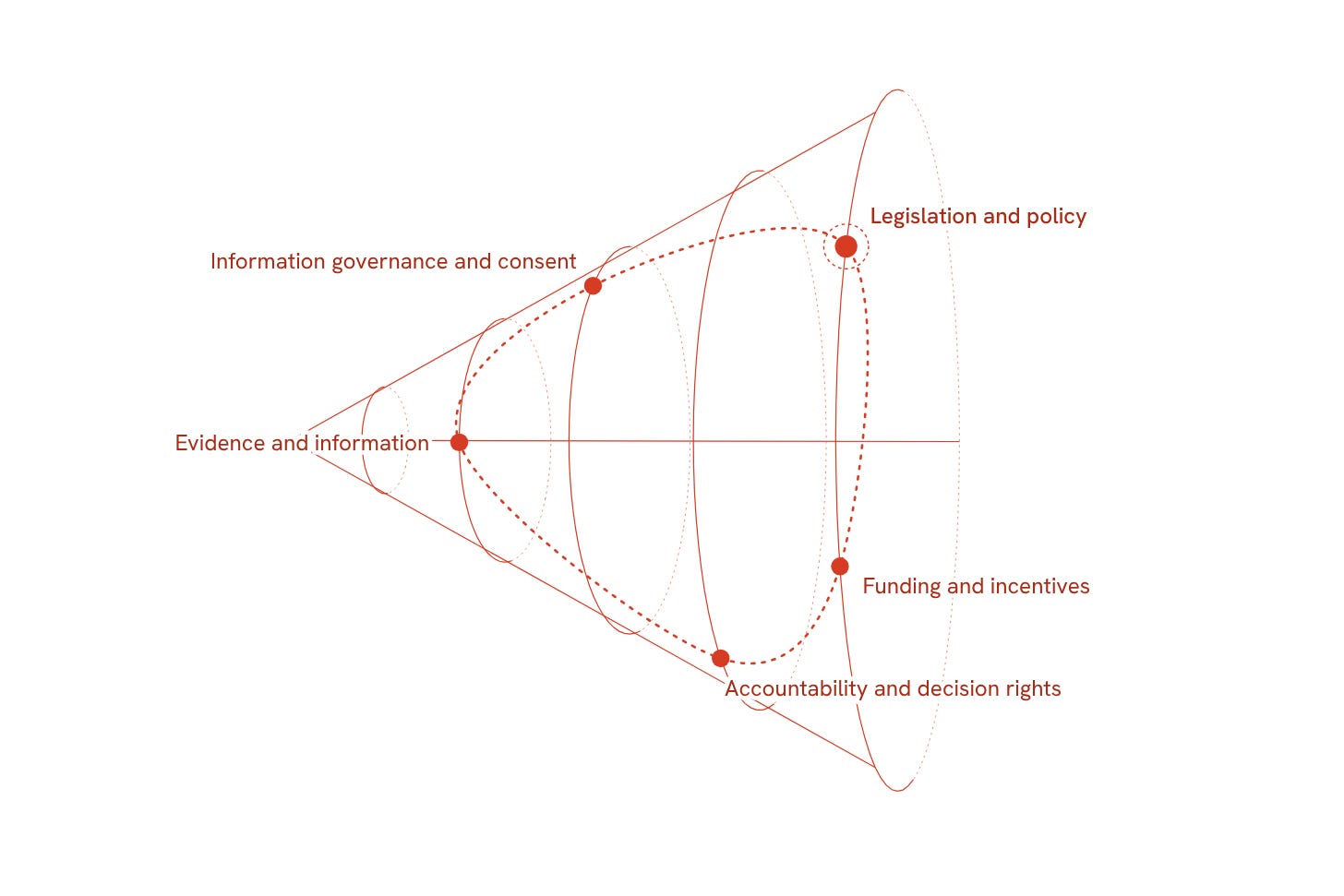
From a practice perspective, interacting with institutional materials is what makes depth tangible. A requirement that initially appears to sit within policy might depend on how professional responsibilities have been allocated, how evidence is collected or who has authority to make a decision. Following those relationships can take an experiment across the institution, showing how its arrangements respond when we try something different and where there might be room to change them.
Experimentation as architecture
I like to think that as you’re slowly finding your way through the treacle, you’re also developing a better sense of what it’s actually made of, and where there might be room to move. Because once you’ve got an experiment off the ground, you never come back to quite the same place. You know a little more about which assumptions are negotiable, which decisions sit elsewhere and which relationships might help you move next time. Some of that can be written down, but much of it sits between people, carried in the conversations and shared experiences that made the experiment possible in the first place. If it’s going to outlast them, it has to be built into the organisation somewhere.
So, for me, the question becomes what an organisation is capable of doing differently because an experiment happened. Beyond simply testing what works, how do we learn from what it took to make the experiment happen?
I’ve previously written about how government is generally terrible at learning. Time and time again, labs, sandboxes and pilots generate learning and the potential to build capability across a whole organisation, yet struggle to translate it into the everyday conditions of how that organisation works. To be blunt, I think that’s because there’s a missing middle between ambition and practice in the civil service. Learning happens, but it arrives downstream of power, caught between what Dan Hill and Anja Melander describe as “nested cultures of decision-making”, where the habits of decision-making at one scale can end up shaping what is possible at another.
This is a huge part of why I’m so passionate about our work at CustomerFirst. I really believe that this emerging practice of public sector experimentation offers an opportunity to build the missing middle from the inside. By bringing the people making decisions closer to the people generating learning, each experiment gives us a chance to develop relationships, capabilities and ways of making decisions that might outlast the experiment itself.
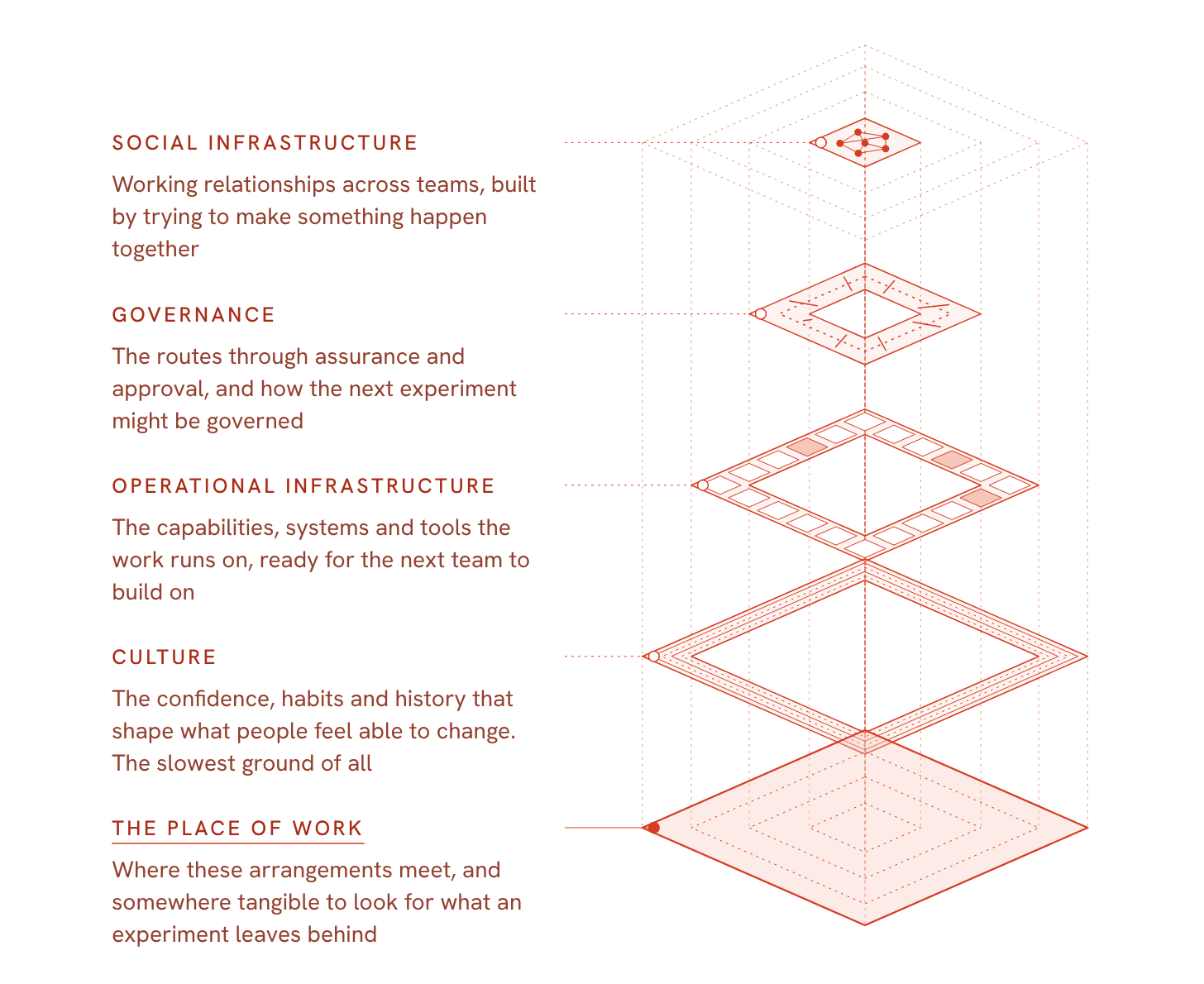
In the social infrastructure of an organisation, Sam Rye writes about experimentation as a practice of reorganising relationships. I think this is one of the most valuable things an experiment can leave behind. Working relationships between policy, technical, operational and frontline colleagues, developed through the shared experience of trying to make something happen. The next time a team needs to work across those boundaries, there’s already some shared understanding of what’s possible, who needs to be involved and how to get things moving.
In the operational infrastructure, experiments can develop capabilities that reach beyond their original purpose. Our digital-return experiment, for example, is an opportunity to establish a capability that could be used much more widely across the service, giving future teams something to build on.
In governance, every experiment has to find a route through assurance and approval, often requiring us to make the case for scrutiny proportionate to the actual risks involved. Through that process, we’re also learning how future experiments might be governed. What interests me is whether those decision-making routes can become available to others, so future teams inherit something more useful than an account of how difficult it was the first time.
In culture, experiments can build confidence through the everyday experience of making change possible. This has been central to how we’ve approached creating the conditions for transformation at CustomerFirst. And the place of work matters here too. For us, that’s DVLA in Swansea, an institution that’s been there for more than half a century, with generations of families working in it, alongside people who’ll still be there long after we’ve gone. Working within the institution gives us an opportunity to build alongside the people who understand its history and are most likely to carry that learning forward.
All of these arrangements lean on one another, and that’s where I think the scaffolding really sits. A relationship with policy colleagues can make a different interpretation possible. That interpretation can open up a different route through governance, which in turn shapes whether a capability developed through one experiment can be used more widely. Together, these relationships and arrangements can begin to change the conditions under which the next experiment happens.
Almost none of it will ever appear on an organisational chart, but perhaps the most meaningful test is whether the next team can pick up where we left off, rather than having to find its own way through the same treacle.
Experimentation as stewardship
Of course, none of this happens without an organisation responding to what we’re trying to change. Systems have many actors, each with their own responsibilities, interests and understanding of what matters. Change rarely moves in the direction we expect, and even the smallest experiment can encounter an extraordinary amount of resistance. It becomes our role as practitioners to hold that tension and care for those around us.
The RSA’s From Design Thinking to System Change describes this as the system immune response, illustrating how innovations can encounter a wall of competing incentives, regulation, organisational cultures and established practices when they try to scale. But I think this response begins much earlier. You encounter it from the very first experiment, as soon as you try to move something through the institution. And as we’ve explored in this article, what looks like resistance can tell us an enormous amount about how an organisation works.
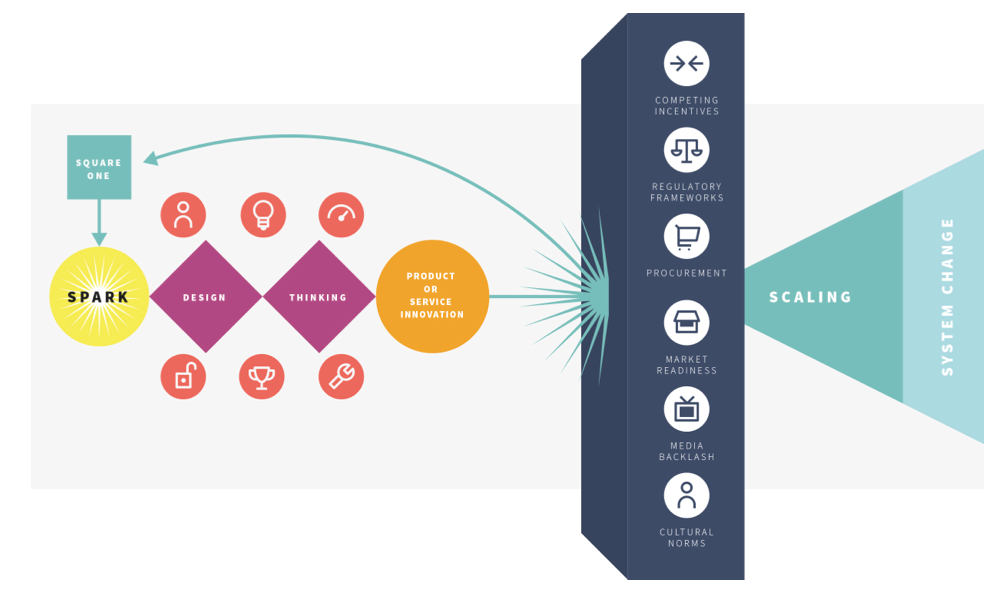
To be really clear for a moment, this response is often entirely reasonable. As Braams and colleagues have shown, reluctance to pursue transformative change can emerge from deeply embedded understandings of what constitutes legitimate public administration. Whilst our mandate as a transformation team to experiment might give our teams permission to begin, it doesn’t necessarily change the responsibilities, decision rights or expectations of everyone around us who keeps the lights on. This is why it’s so important to understand that what feels like an immovable middle of an organisation could look rather different when you understand the consequences people are accountable for.
It’s worth considering that some of this friction can be healthy too. It can protect important principles of public administration, while other responses can grow around precedent, perceived risk or assumptions that have become difficult to question. The difficulty is that these can look remarkably similar when you’re trying to make something happen.
This is where stewardship becomes such an important part of experimentation. It takes time, care and a willingness to work through those responses with the people responsible, learning where there’s genuine room to move and where something important needs protecting. I’ve previously written about the bureaucracy we need and the bureaucracy we can cut, and as Rainer Kattel has recently argued, treating innovation only as disruption misunderstands the institutions, capabilities and practices through which most public value, and hence trust and legitimacy, is actually produced. Sometimes that means starting smaller, changing the experiment or investing in a relationship long before the thing you wanted to test can happen. Sometimes it means holding firm when the constraint itself is what needs to change.
Improving the present or modelling the future?
What I’ve been wrestling with most through our work at CustomerFirst is what we’re ultimately experimenting towards. There is enormous value in improving the services we have. Hell, a small change might mean someone receives their driving licence earlier and can get to work tomorrow. And these improvements matter, as they often give us the evidence, momentum and capabilities to pursue something more ambitious in the long run.
Yet the ambition of actual transformation asks us to start somewhere else. Because if we begin with the public value we want to create, how might we organise the people, technology and processes needed to achieve it? And how much of that future organisation can we begin to model through the experiments we’re running today?
Much of this article has been an attempt to explore these practices. Not as a framework or a how-to, but as a way of looking at and holding transformational change, the kind that rewiring the state is going to need, and of getting to know the treacle well enough to start changing it.
References & further reading
Braams, R. B., Wesseling, J. H., Meijer, A. J. and Hekkert, M. P. (2022) ‘Understanding why civil servants are reluctant to carry out transition tasks’, Science and Public Policy, 49(6), pp. 905–914. https://doi.org/10.1093/scipol/scac037
Brand, S. (2018) ‘Pace Layering: How Complex Systems Learn and Keep Learning’, Journal of Design and Science, 3. https://jods.mitpress.mit.edu/pub/issue3-brand/release/2
Conway, R., Masters, J. and Thorold, J. (2017) From Design Thinking to System Change: How to invest in innovation for social impact. London: RSA Action and Research Centre. https://www.thersa.org/reports/from-design-thinking-to-system-change
Hill, D. (2022) Designing Missions: Mission-oriented innovation in Sweden, a practice guide by Vinnova. Stockholm: Vinnova. https://www.vinnova.se/contentassets/1c94a5c2f72c41cb9e651827f29edc14/designing-missions.pdf
Hill, D. and Melander, A. (2025) ‘Strategic Design for Public Purpose: Enriched and Expanded Practices for Human-Technology Interaction’, in Human-Technology Interaction. Cham: Springer. https://doi.org/10.1007/978-3-031-78357-9_2
Kattel, R. (2026) ‘The capability state’, Rainer Kattel (Substack), 26 October.

Moore, M. H. (1995) Creating Public Value: Strategic Management in Government. Cambridge, MA: Harvard University Press: https://www.hks.harvard.edu/publications/creating-public-value-core-idea-strategic-management-government
Pagh, C. and Cook, T. (eds) (2023) Mission Neighbourhood: (Re)forming Communities. Copenhagen: Arkitektens Forlag. (Socio-spatial layers, adapted for the organisation diagram): https://bookshop.aaschool.ac.uk/?product=mission-neighbourhood
Rye, S. on experimentation as a practice of reorganising relationships. https://www.samrye.xyz/further-experimentation-practice-part-1/
Strachan, J. (2025) (Re)imagining Mission Neighbourhoods: Emerging Practices of Urban Transformation. UCL Institute for Innovation and Public Purpose. MPA Thesis. (This is me!): https://www.ucl.ac.uk/bartlett/sites/bartlett/files/2026-02/(Re)imagining Mission Neighbourhoods.pdf
This is a really interesting read about starting with change of a relatively simple transactional process. Applying a test and learn method around its development. Then recognising that much of the change is not about the process itself, but about a much of what our organisations are about. And much of that is not physical, but behavioural and exists in the gaps between.
Systemic design.
Thanks Jack.