


For more than a decade, small, empowered, multidisciplinary teams have sat near the centre of digital government’s theory of change. They’ve driven reform by putting different capabilities around the same work, close enough to understand what citizens are actually trying to do, trusted enough to follow the evidence, and clever enough to build and change things as they learned. At their best they’ve given government something it had struggled to build for years.
Then government did what government does with anything that works. It made it legible. Roles became professions, professions grew capability frameworks and career paths, teams took on recognisable shapes, and those shapes became easy to recruit, grade, fund, report and hold to account [^1]. All the necessary, governmenty things that gave digital capability a permanence in Whitehall it would never have had otherwise.
But legibility has a cost. Because whilst we have become very good at assembling teams capable of running services, improving them and making them better over time, we have become much worse at preserving the judgement, trust, permission and relationships that made those teams transformational in the first place.
This matters now. Because if we’re talking seriously about rewiring the state, rebuilding government around outcomes, missions or whole services, that work will not stay where we put it. It will cross professional boundaries, organisational boundaries and the lines between delivery and policy itself. This type of transformation needs teams with permission to follow problems, agency to act on what they learn, and enough flexibility to change shape as their understanding changes. And these are exactly the conditions the machinery of government is least well set up to provide.
So, are multidisciplinary teams still the right foundation for the kind of transformation we now say we want? Or have the structures we built to break the silos quietly become silos of their own?
Expanding how we think about working together
In the quest for legibility at scale within government, multidisciplinary working has become something of a shorthand for an entire philosophy of empowered working. Partly, that is a legacy of what the original GDS teams made look so easy. Relational, integrated, flexible, trusted, able to cross a boundary when the work asks for it. All qualities that became bound up with what good multidisciplinary working in government was supposed to look like. But it also tells us something about how government scales what works. We put enormous effort into the parts we can describe, formalise and reproduce, building line management, funding routes, career paths and professional boundaries around the separate forms of expertise that make up a team.
The consequence, however, is that the version of multidisciplinarity government has become best at reproducing is also the most legible one. It is the definition of multidisciplinary that has scaled most faithfully – specialists working alongside one another while retaining their own disciplinary approaches and perspectives [^2] – rather than all the characteristics we came to associate with those original teams. Which is a considerably smaller promise than the one we’ve been making.
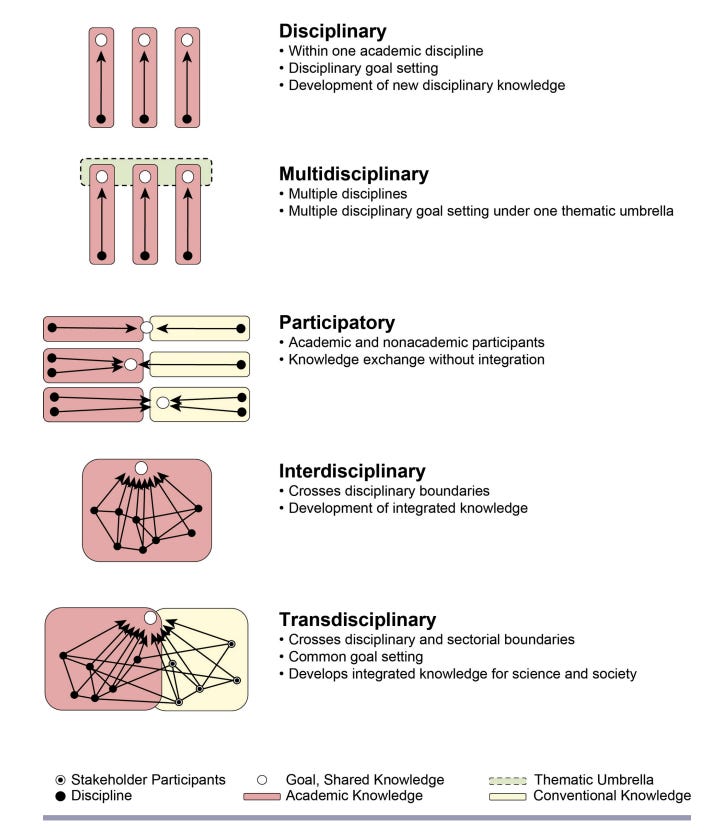
This difference is more than semantic, and becomes uncomfortably obvious when you see it drawn. This typology of relationships between disciplines comes from a study on how large, multi-institutional research programmes organise themselves around complex problems [^3]. And there, multidisciplinary – the word government has loaded with a much broader philosophy of empowered working – is almost brutally simple. Separate disciplinary columns, each with its own goal, sitting under a shared thematic umbrella.
Put that beside the shape of a mature government service team and the resemblance is hard to miss. Teams of researchers that research. Designers that design. Analysts that analyse. Policy that sits somewhere else. Everyone doing their own job well, more often than not still bloody brilliantly. But I think this is the trap we’ve fallen into. Government has learned to organise the work around the professions we’ve assembled, rather than organise those professions around the outcome. And when the work has to travel between those territories, every handover creates another opportunity for tacit knowledge, learning and perspective to get lost along the way. Familiar, right?
Where these diagrams become even more useful is in giving us a vocabulary we’ve perhaps been missing. Participatory brings people from beyond the disciplines into the work and creates knowledge exchange, while the disciplinary knowledge itself remains largely separate. Interdisciplinary goes further, integrating knowledge across disciplinary boundaries. And then transdisciplinary crosses boundaries between disciplines and sectors, forms goals in common and produces knowledge together rather than passing it between established professional territories. It looks much closer to the kind of movement rewiring the state seems to demand, and we have never really had a word for it in government.
So while multidisciplinary teams can contain excellent researchers, designers, technologists, analysts and product people, multidisciplinarity itself only tells us that those forms of expertise are present. It does not tell us whether knowledge is integrated, whether authority can move, whether the team can cross organisational or policy boundaries, or whether its shape can change when the problem changes.
All of which points at an obvious answer. If multidisciplinary is too small, perhaps what government needs is transdisciplinary teams. If only it were that simple.
When the work moves
One of the clearest things I’ve learned from working on service and policy problems across government is that the work rarely stays in the place, profession or part of the system where it first appears. A citizen cannot complete something, so the obvious place to start is the service. But the service works the way it does because of an operational rule. The rule exists because a particular piece of evidence is required. That evidence requirement encodes a judgement about risk, and that judgement was made somewhere else entirely against a policy intent nobody in the room wrote. Again and again, somewhere along that chain, the thing that first presented itself as a service problem stops being one.
Put simply, the work moves. Horizontally across different kinds of expertise, from design into operations, evidence, analysis and policy, which is the movement much of the literature on cross-disciplinary working helps us understand.
But it also moves vertically, through layers of institutional authority. From an interaction to a process, from a process to a rule, from a rule to the judgement or policy that put it there in the first place. And this is the tricky part for multidisciplinary teams. They can contain every relevant profession and still have no route through those layers. Nobody is missing from the team, but the authority to follow the problem sits somewhere else.
This is where transdisciplinary working starts to act as a genuinely useful lens. It gives us a way of thinking about expertise organised around the problem rather than handed between professional territories, crossing disciplinary and sectoral boundaries where the work demands it.
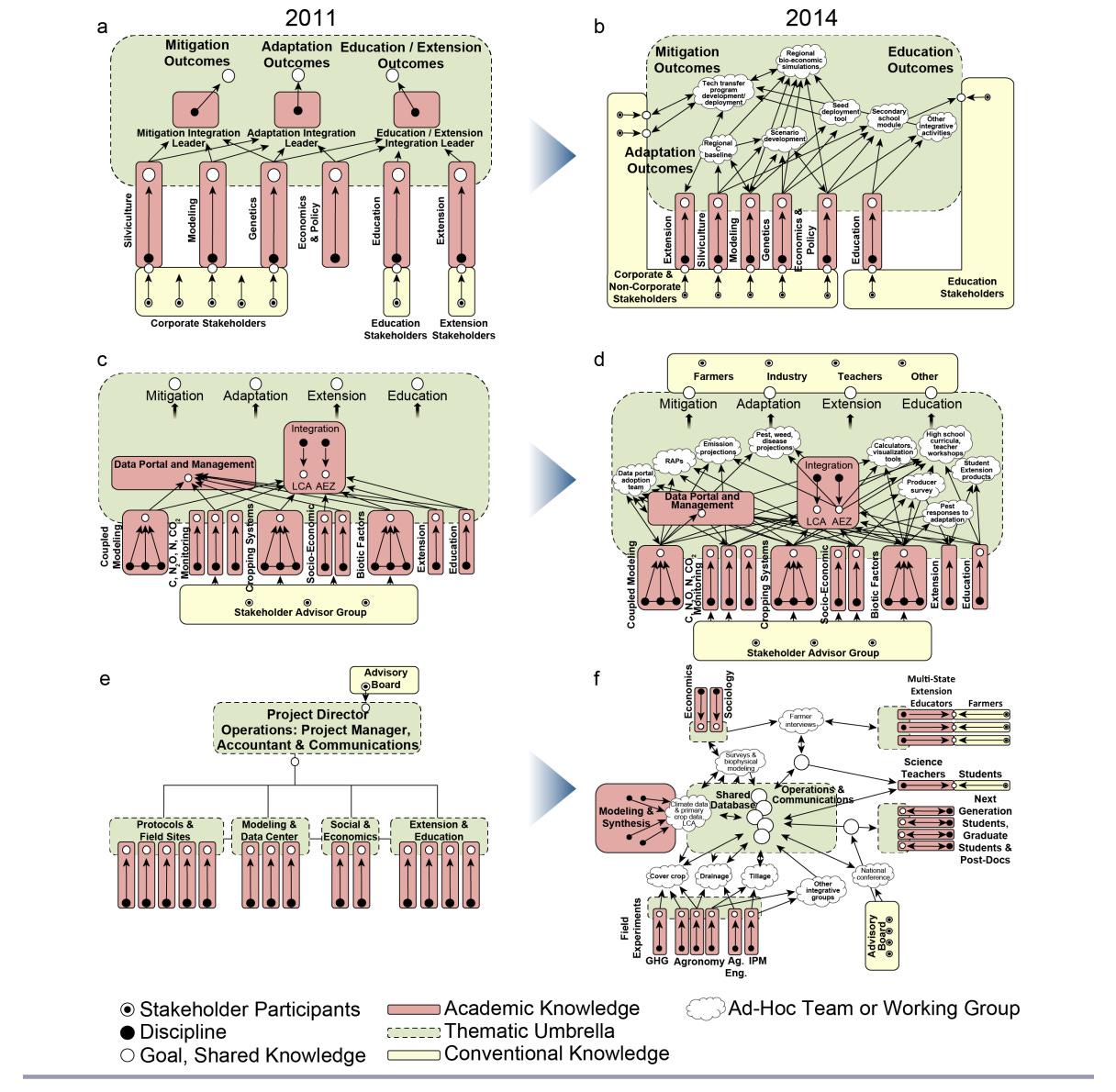
What this ends up looking like in practice is much closer to the kind of working those original GDS teams made familiar. Messy, relational, crossing boundaries and organised around an outcome rather than a fixed set of professional territories. Different combinations of people form around different parts of the problem, some lasting, some temporary, some crossing disciplines and others staying firmly within them. The architecture gets denser as the work develops because understanding a problem creates new questions, and those questions demand different combinations of expertise and relationships.
What that illustrates, really, is that the team you planned for does not always end up being the team the work needs. As the work evolves and the conditions around it change, the useful mix of skills, relationships and authority changes with it. And if the work itself cannot be fully specified upfront, neither can the architecture required to do it. That puts our business as usual governance in an awkward position, because much of the machinery we use to organise, fund and assure work assumes its shape can be known at the start. The evidence has to be able to change the structure as the work develops.
This is what the authors of these diagrams call architectures of adaptive integration. The structures and processes, formal and informal, through which different groups work together on a shared problem over time. And the point of the phrase is the movement in it. Relationships form and dissolve, different expertise becomes important at different moments, and the architecture keeps adapting to what the work is teaching.
Building depth that travels
The obvious answer at this point would be to go and build transdisciplinary teams across government. But the reality of transformation work is messier than that. Disciplinary, multidisciplinary and transdisciplinary work happens at the same time, often inside the same programme, because different questions demand different relationships between expertise. Some of it needs deep specialist craft. Some of it needs several professions working alongside one another. Some of it needs people to cross those boundaries entirely.
This is part of what we’re learning through CustomerFirst. Through our NewCo partnership with DVLA we started with a deliberately loose structure, organising workstreams around some of the biggest opportunities for transformation. But the muscle memory of professions has a funny way of kicking back in. Over time, we found those workstreams drifting towards technology, data, governance and organisation design silos. We have been trying to push back against that by reorganising around the future service processes and outcomes we are trying to create, using a shared view of that future service to hold the work together while different combinations of people form around it as the work changes. What we keep coming back to is that our aim shouldn’t be to preserve the org chart we happen to have today. It should be to keep asking what team we need for the work ahead.
That way of working hasn’t required anyone to abandon their craft. People step into unfamiliar areas when the work needs it, share knowledge and ownership across disciplines, and contribute beyond the usual edge of their role. The emerging learning is that the boundaries around that craft can be permeable enough for people to contribute past them, while still knowing where their expertise ends and when somebody with deeper knowledge needs to come in. We’re still figuring out where that works and where it doesn’t, and likely making plenty of mistakes along the way. Most of this movement has happened because individuals have made it happen, which is effort rather than architecture. We’re learning that if the same people keep bridging the gaps, those bridges have to become part of the model.
And that gets closer to the proposition underneath all of this. People need to keep their professional depth while the architecture around that depth becomes more fluid. The two depend on each other. You need enough mastery to understand what your field contributes, where its limits are, what you can safely carry across a boundary and whose knowledge needs to enter next. This is what Helga Nowotny argues in her 2003 paper Democratising expertise and socially robust knowledge; that expertise increasingly involves building links between what experts know and what other people need to know and do, and that feels remarkably close to the capability we are trying to create through CustomerFirst.
Which is why the professions still matter, as platforms rather than silos [^4]. Strong places to develop craft, methods, standards and professional community, but places people can launch from as the work demands different combinations of knowledge. Somewhere solid to stand, without deciding in advance where the work is allowed to go. The profession supplies the depth. The work determines how that depth combines with everything else around it.
The real danger is what government does next with all of this, which is try to institutionalise it. Making something legible at scale usually means making enough of it repeatable, and transformation, infamously, isn’t, despite what the McKinseys of the world tell you. Make fluid working easier to manage from a distance and the temptation will be to give it firmer edges, define the roles and write more of the instructions down. We have done versions of this before, creating structures intended to preserve a different way of working that eventually make that way of working harder [^5].
Transdisciplinarity is a practice, not an institution
The alternative is structures that enable the practice without fixing it in place. Which leaves a fairly practical question. If the answer is not another prescribed team shape, how would you know whether the conditions for this kind of working actually exist?
The characteristics of adaptive integration offer a useful lens. Not a framework to implement, or a checklist every multidisciplinary team should suddenly pass, but a way of looking at complex work when it starts to strain against the structure around it. When the problem keeps crossing boundaries, when the expertise you need changes as you learn, or when the team can see where the work needs to go but does not have a route to get there, these are useful questions to ask.
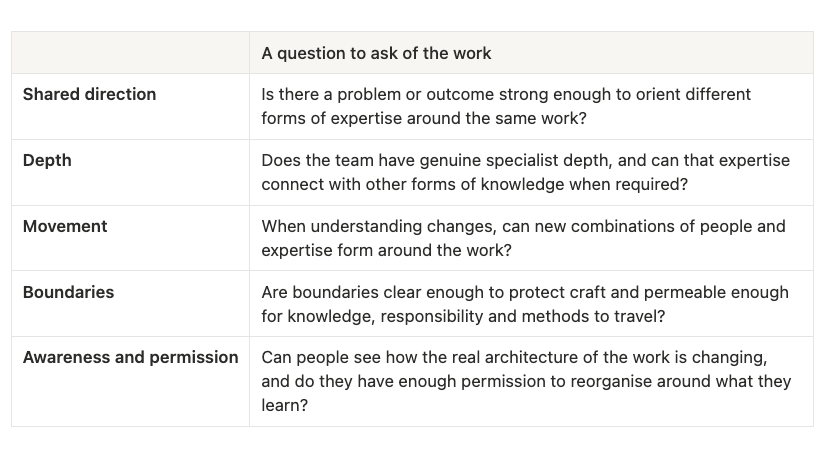
These are probably most useful as questions asked during the work and revisited as it changes, not as criteria settled before it starts. A team might look perfectly healthy against them at one point and find six weeks later that the problem has moved, a new form of expertise has become important or an organisational boundary has become the thing stopping progress. The point is to notice those changes and be able to respond to them.
They are deliberately questions rather than a maturity model. Turning adaptive working into five levels of transdisciplinary maturity would rather spectacularly miss the point.
Is this what we meant by empowered teams?
Adaptive integration points us somewhere government does not usually look. People inside complex work need enough awareness of the architecture forming around them to see where knowledge sits, where it is getting stuck, which relationships are emerging and where new ones are needed. Call it sideways legibility. Making the structure visible to the people trying to move through it, rather than only to the people trying to manage it from above.
And that gets us back to empowered. Enough freedom to follow the work when it moves, bring different expertise around it and change the shape of the team as understanding changes. This is why the future isn’t multidisciplinary, at least not in the way we’ve come to use the word. The same professions may still be there, and multidisciplinary working will still be useful. What cannot stay fixed is the architecture between them. When professional boundaries determine where the work can go, the structures we built to break the silos start behaving rather a lot like silos themselves.
I recognise there are plenty of questions left hanging. What this means for the politics of professionalisation, when digital specialists spent years fighting for the standing that professions gave them. And how people get good at moving horizontally across disciplines and vertically through institutions without sliding into generalism, which is close to what I was circling in my analysis of the Public Design Gap and my practice notes on testing and learning.
Those feel like places to keep exploring rather than answer now. So instead, here is a provocation. If the future team contains exactly the same professions as today’s, and what needs to change is the architecture between them, who in government is responsible for creating the conditions that let that architecture move?
Footnotes
Professions, capability frameworks and career paths. Patrick Dunleavy, Helen Margetts, Simon Bastow and Jane Tinkler, Digital Era Governance: IT Corporations, the State, and e-Government (Oxford, 2006): Their account of why technical specialists were kept in professional enclaves, away from the top of the civil service, is worth reading alongside anything about digital professions. UK IT occupations only secured recognition as a civil service occupational group on a par with others in 2004–5, seven years before GDS existed. The frameworks solved a real and old problem.
Specialists working alongside one another. Alice Russell, Fern Wickson and Anna Carew, “Transdisciplinarity: context, contradictions and capacity”: Their formulation is that multidisciplinarity is where disciplinary specialists work together maintaining their disciplinary approaches and perspectives, interdisciplinarity investigates the areas of overlap between disciplines, and transdisciplinarity transgresses and transcends disciplinary boundaries altogether.
The typology. Lois Wright Morton, Sanford Eigenbrode and Timothy Martin, “Architectures of adaptive integration in large collaborative projects”, Figure 1 is redrawn in their paper from Tress, Tress and Fry, “Clarifying integrative research concepts in landscape ecology”. Figure 2 shows three USDA-funded climate and agriculture programmes, proposed in 2011 by 115 principal investigators across 27 institutions, as they were structured at conception and as they had organised themselves by 2014. The structures were observed rather than proposed, tracked over four years through surveys, focus groups, interviews, archived meeting records, external evaluation, social network analysis and ethnography.
Platforms rather than silos. The phrase is Russell, Wickson and Carew's. They propose that strong foundations of intellectual capacity, including disciplinary ones, could act as platforms rather than silos: places to respond to problems flexibly and to launch from, without fixing the institution into particular strengths and trajectories.
Structures that destroy the flexibility. Russell, Wickson and Carew again. Writing about universities, they watched cross-disciplinary work get captured by the institutions that valued it, consolidated into designated research strengths and priority areas selected largely on commercial potential. Australia’s Cooperative Research Centres programme funded 16 centres in 2004, roughly half the 2002 number and selected down from over 50 initially established. What institutionalisation produces, they argue, is mega-silos: new structures built vertically as islands of strength, replacing disciplinary boundaries with topic and industry ones, with cross-disciplinary work starved of resources in the spaces between. Their conclusion is that structures built to institutionalise transdisciplinary activity are unlikely to succeed and are in fact an anathema to the flexibility and responsiveness required. What they argue for instead is enabling structures: opportunities for interaction, researcher-driven groupings, incentives and quality criteria.
Thats a truly well thought out piece. You can feel the experience dripping from the paragraphs. You are taking the simplistic ideas that so many write about, and delve far deeper into the reality of relational working, and the concepts behind it.
I really like how you move from multi-disciplinary, to inter-disciplinary, to trans-disciplinary. Of course, to make any of that happen, so much of what we believe to be design today needs to be rethought.
Such an interesting article!